Eight-Tank Facility Enters a Long-Term Modernisation Cycle
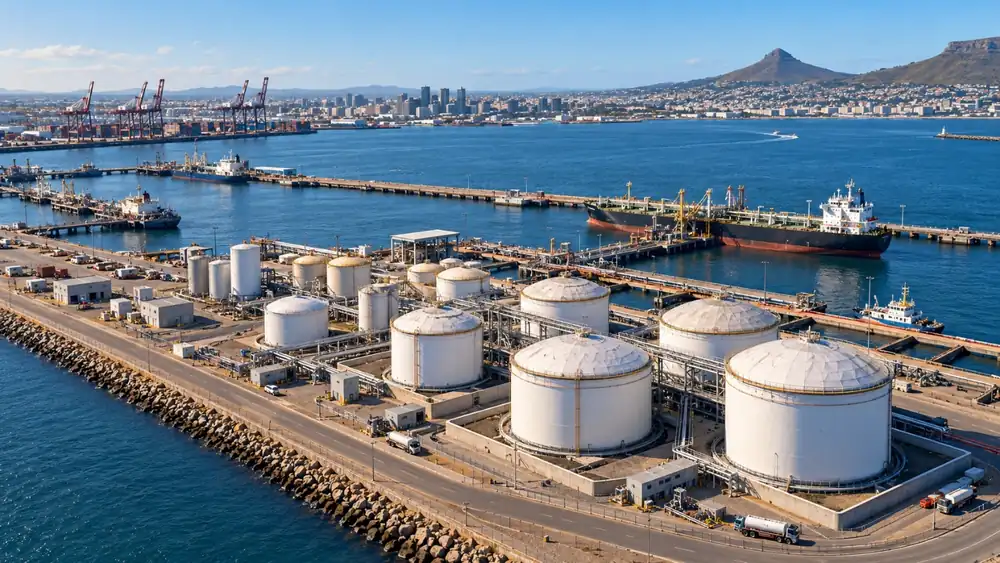
Transnet National Ports Authority opened a Request for Proposals in May 2026 for a terminal operator to finance, operate, maintain, refurbish and/or construct a liquid-bulk terminal at the Port of Cape Town under a 25-year concession.
The brownfield site contains eight storage tanks with approximately 44,430 m³ of combined capacity, together with an adjacent warehouse and administration building. The facility interfaces with common-user berths at Tanker Basin 1 and Tanker Basin 2, supporting refinery supply as well as imported bunkering products.
For Cape Town’s liquid-bulk sector, the opportunity brings existing tank assets into a long-term infrastructure and operational strategy rather than treating storage as a standalone capacity issue.
Bunkering Capability Adds Another Reliability Requirement
TNPA’s official scope specifically includes bunkering and related services, making the condition and availability of tanks, pipelines, transfer infrastructure and berth interfaces important to overall terminal performance.
Brownfield facilities also create a different challenge from new-build terminals. Existing infrastructure must continue supporting operational demand while refurbishment, maintenance and modernisation priorities are addressed.
For operators, this places attention on inspection planning, corrosion management, structural condition, transfer-system reliability and maintenance sequencing. Effective modernisation must improve asset performance without compromising the continuity of critical terminal services.
A 25-Year Concession Makes Lifecycle Performance Critical
TNPA has said the RFP is intended to retain and enhance a strategically important liquid-bulk facility while improving infrastructure utilisation, operational efficiency and bunkering capability.
A 25-year operating horizon makes lifecycle planning especially significant. Storage tanks and associated infrastructure will require disciplined inspection, repair and maintenance strategies capable of responding to ageing mechanisms and changing operational requirements.
Digital condition monitoring, risk-based inspection and better integrity-data management can further support operators in prioritising intervention across complex brownfield assets.