


Three Consecutive Months Above the OPEC Threshold
Nigeria maintained compliance with its OPEC crude oil production quota for a third consecutive month in July 2026, reinforcing the country's recent upstream production recovery.
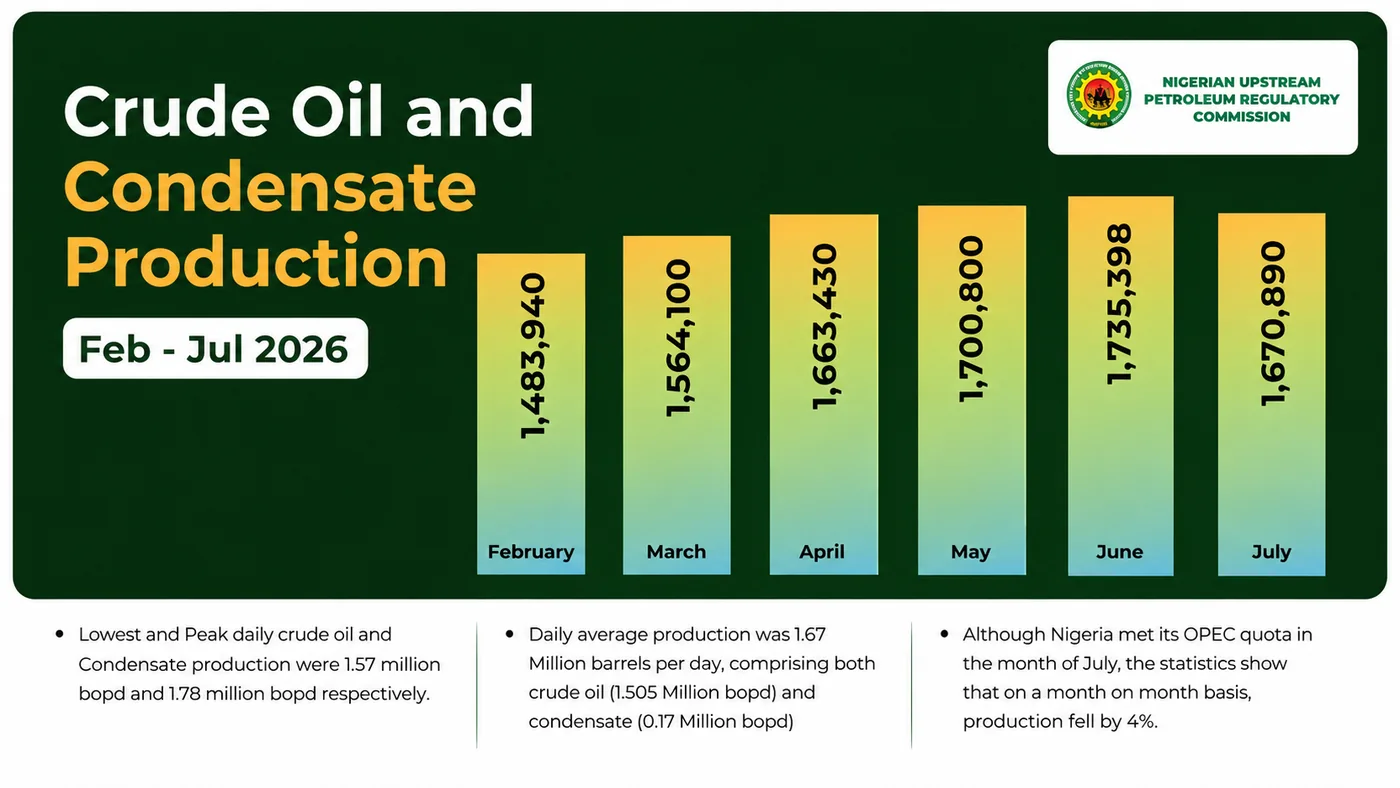
According to the Nigerian Upstream Petroleum Regulatory Commission, Nigeria produced an average of approximately 1.505 million barrels per day of crude oil during July, slightly above its 1.5 million bpd OPEC quota.
Condensate production contributed approximately 0.17 million bpd, bringing combined crude oil and condensate output to around 1.67 million bpd.
Daily production during the month ranged between approximately 1.57 million bpd and a peak of 1.78 million bpd.
For Nigeria's upstream sector, maintaining quota compliance for three consecutive months is significant. The next challenge is ensuring that this level of performance can be sustained consistently across producing assets.
Sustained Production Matters More Than a Single Peak
Nigeria's combined production increased steadily from approximately 1.484 million bpd in February to 1.564 million in March, 1.663 million in April, 1.701 million in May and 1.735 million in June.
July output moderated to approximately 1.671 million bpd, representing a month-on-month decline of around 4%.
The decline does not erase the broader improvement. Instead, it demonstrates why production optimization must focus on stability as much as growth.
Operators need to understand why production varies between peak and average levels, identify operational constraints early and prevent temporary performance losses from developing into prolonged production deferment.
Protecting Existing Barrels Becomes the Next Priority
NUPRC noted that operational challenges affected production during the month, while production across other assets remained relatively stable. Routine production activities and crude evacuation operations were also largely sustained.
This places greater importance on proactive asset management.
Condition monitoring, predictive maintenance, production surveillance and reliability engineering can help operators detect emerging problems before they significantly affect output. Integrated data across reservoirs, wells, processing facilities and evacuation systems can also enable faster operational decisions.
Production optimization is therefore not limited to drilling new wells or adding capacity. Protecting existing production, improving uptime and maintaining reliable evacuation routes are equally important to sustaining national output.


